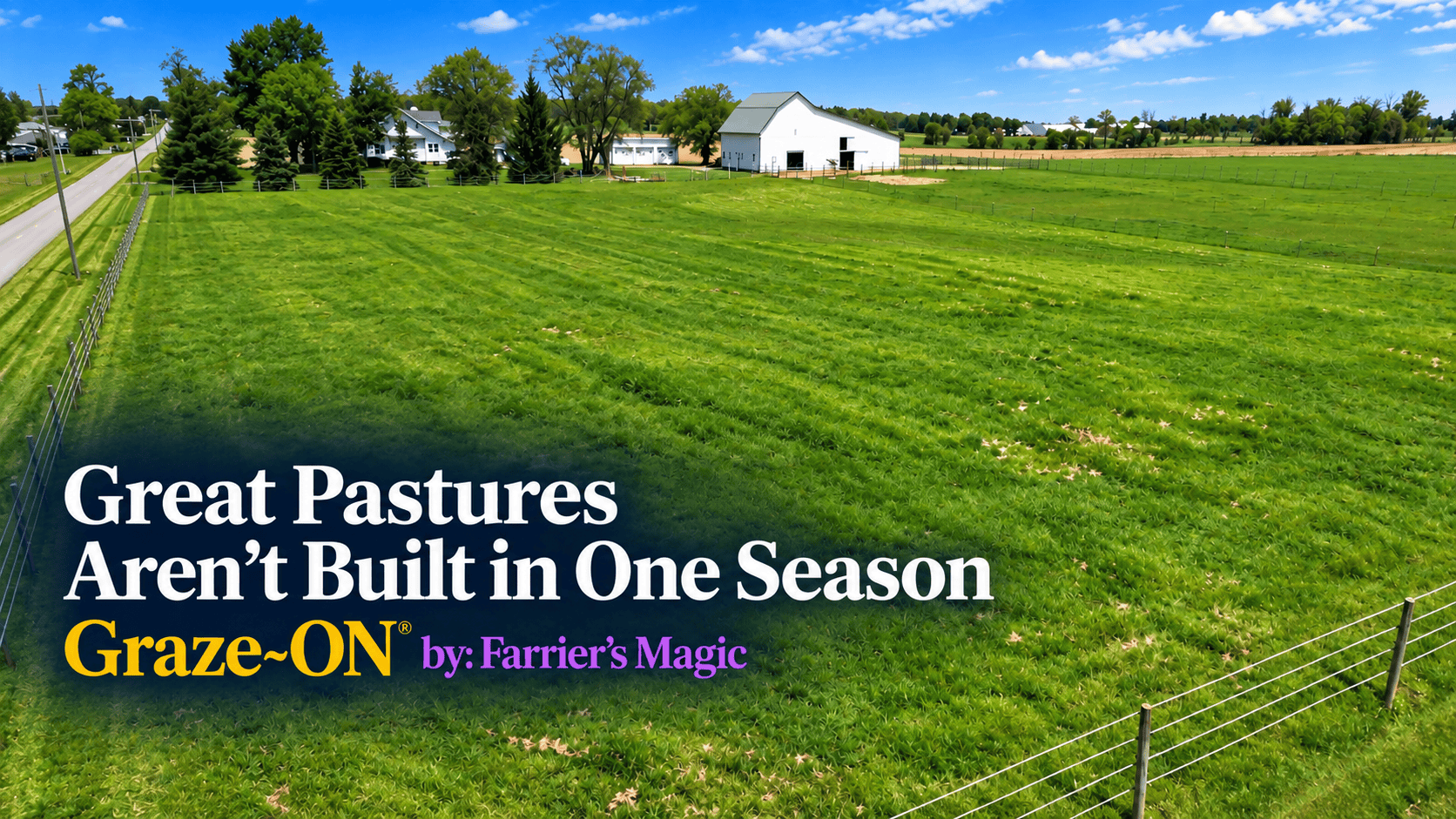
Horse owners often hope that one application, one mowing or one round of reseeding will bring the grass back. In reality, pasture problems usually develop over time, and meaningful improvement often takes time as well.
That is why we recommend approaching Graze~ON as a three-year commitment rather than a one-time treatment.
A struggling pasture may be dealing with more than a lack of fertilizer. Heavy grazing pressure can prevent grass from recovering. Compacted soil can limit root growth and water movement. Poor drainage can create muddy areas, while drought can weaken already-stressed plants. Weed seeds may also have accumulated in the soil over many growing seasons.
One application cannot correct all of those conditions. A consistent program, paired with good pasture-management practices, can begin moving the pasture in the right direction.
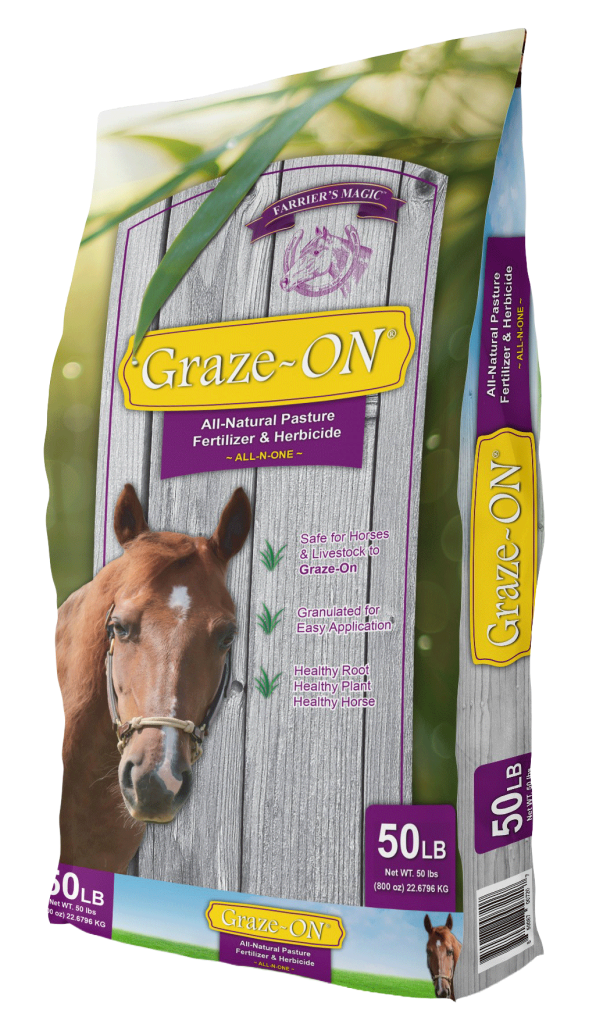
Graze~ON by Farrier’s Magic supports established grass through a combination of corn protein meal, or CPM, and sunflower hull ash. The CPM supplies nitrogen to encourage healthy, dense growth while providing natural pre-emergent activity that helps reduce newly germinating weeds.
Graze~ON does not kill weeds that are already growing. Mowing is still necessary to manage mature weeds and help prevent them from going to seed. This creates a two-part approach: mowing addresses what is currently visible, while Graze~ON helps reduce the next generation as it begins to germinate.
Sunflower hull ash supplies potassium to support root development, plant strength and stress tolerance. Healthy roots allow grass to make better use of available water and nutrients, giving it a stronger foundation for handling drought, grazing and everyday farm traffic.
The most successful pasture plans look beyond the product being applied. Rotational grazing gives grass time to rest and regrow. Reseeding may be necessary where the stand has become too thin to recover on its own. Drainage problems should be addressed so grass roots are not continually sitting in saturated soil. Compacted areas may need special attention, particularly around gates, water sources and feeding locations.
Grazing pressure must also match what the land can support. Even a well-established pasture will struggle if horses repeatedly graze the grass too short or remain on the same area without adequate recovery time.
Every farm has different needs, acreage and financial limits. Graze-ON can be applied throughout an entire pasture or focused on the areas that need the most help. Starting where you can and following a plan consistently is more valuable than attempting an approach that cannot be maintained.
Pasture improvement is not about perfection. It is about making steady, thoughtful decisions that build on one another. The first year begins supporting the grass and interrupting new weed establishment. Continued management during the following seasons helps protect that progress and strengthen the pasture.